"What is your greatest weakness?" How to answer, with examples for engineers
TL;DR
- Use 3 parts: name a real, specific weakness that isn't core to the job, give one moment it actually cost you, then explain what you changed and the result.
- Avoid fake weaknesses ("I'm a perfectionist", "I work too hard") and weaknesses that are the main skill of the role.
- Keep it to about 45 to 60 seconds and end on the improvement, not the problem.
"What is your greatest weakness?" is asked in HR rounds, hiring manager rounds and campus placements alike. It feels like a trap, but the interviewer usually wants to know two things: are you self-aware, and do you improve?
This post gives you a simple structure, example answers for engineers and freshers, and the answers to avoid.
Try the free STAR Method Answer Generator
Turn a rough story into a structured STAR answer for behavioral interview questions. No sign-up.
What the interviewer is really checking
- Self-awareness: can you see your own gaps honestly?
- Growth: when you notice a problem, do you do something about it?
- Fit: is the weakness a serious problem for this particular job?
A fake weakness fails the first test. A weakness with no fix fails the second. A weakness in the core skill of the job fails the third.
The 3-part structure
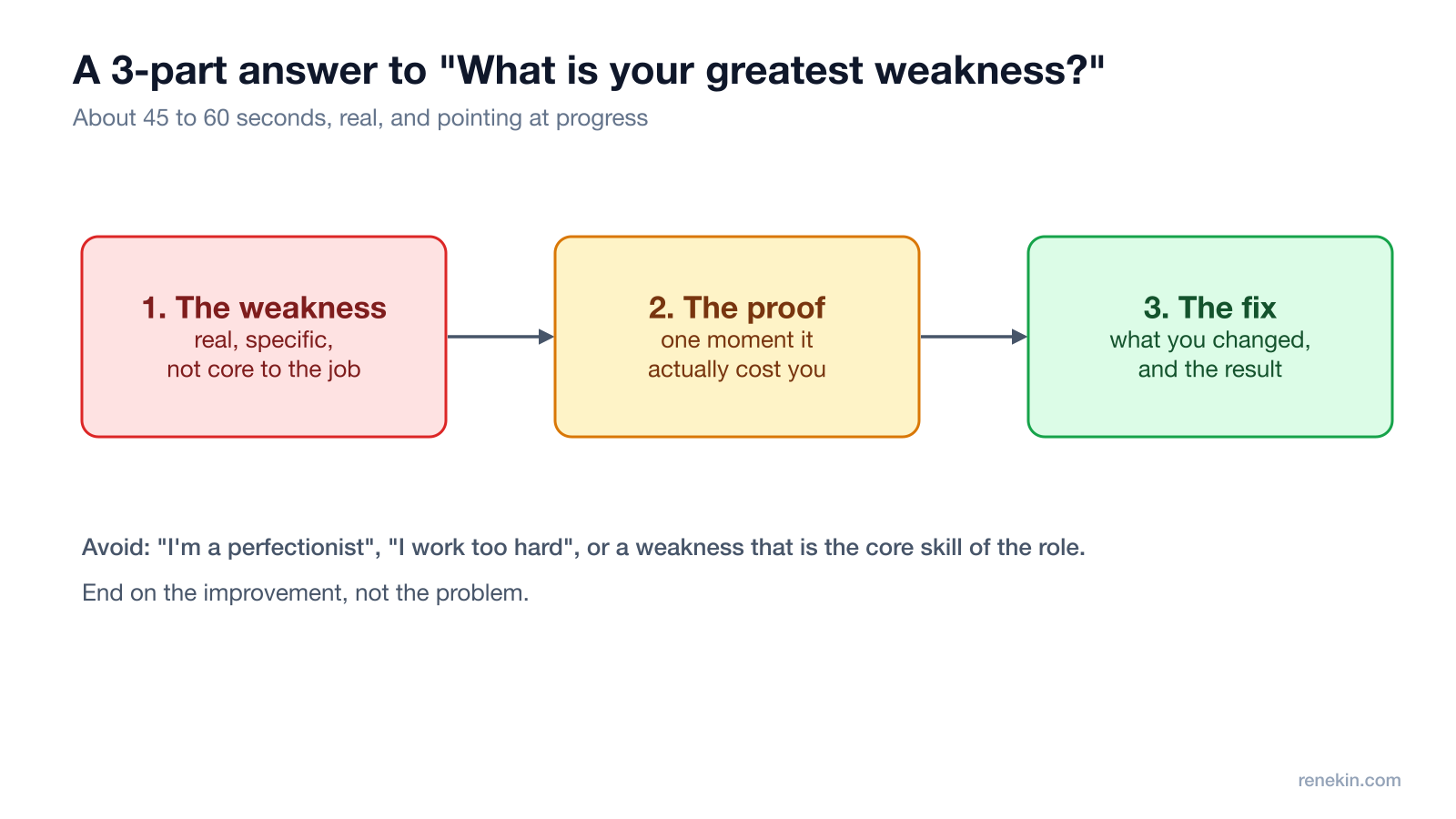
- The weakness: real, specific, and not central to the role. One sentence.
- The proof: one short moment when it actually caused a problem. This makes it believable.
- The fix: what you changed, and what's different now. Spend most of your time here.
It's close to the STAR method, shortened for a single question.
Example answers
Software engineer: not asking for help early enough
"I used to try to solve every problem alone before asking anyone. In my last role, I spent two days stuck on a build issue that a teammate fixed in twenty minutes once I asked. Since then, I set myself a time limit: if I'm stuck for about an hour with no progress, I write up what I've tried and ask. I get unblocked much faster, and the write-ups have helped others too."
Software engineer: over-polishing before review
"I tended to polish code for too long before opening a pull request. On one feature, I'd built a lot before review, and the reviewer pointed out a design change that meant redoing a big part of it. Now I open small draft pull requests early and ask for feedback on the approach first. Reviews are faster and I rarely have to redo large chunks."
Fresher: underestimating how long tasks take
"I often underestimated how long work would take. In my final-year project, I promised a demo by a date and we had to cut a feature at the last minute. Since then, I break tasks into small steps, estimate each one, and add buffer for testing. In my internship, I delivered my tasks on the dates I gave."
Anyone: presenting to large groups
"I'm less comfortable presenting to large groups than in one-to-one conversations. In college, I rushed through a seminar talk and skipped key points. I've been practising by presenting in our team demos and recording myself beforehand. I'm much calmer now, and I volunteer for demos instead of avoiding them."
Weaknesses to avoid
- Fake ones: "I'm a perfectionist", "I work too hard", "I care too much". Interviewers hear these constantly.
- Core skills of the job: a backend engineer saying "I struggle with databases", or a support role saying "I don't like talking to people".
- Character red flags: "I lose my temper", "I miss deadlines a lot", with no evidence of change.
- No weakness at all: "I can't think of one" reads as low self-awareness.
Follow-ups to prepare for
- "Can you give another weakness?" Have a second, smaller one ready, with the same structure.
- "How do you know it's improved?" Point to something visible: faster reviews, deadlines met, feedback from a manager.
- "What would your manager say your weakness is?" Use the same honest answer; it should match what you've already said.
Practise it out loud
Write your answer down, read it aloud, and time it: it should take about 45 to 60 seconds. Then practise it with the other common questions in an HR round, such as tell me about yourself. You can draft a structured answer in seconds with our free STAR method answer generator.
Frequently asked questions
What is a good weakness to say in an interview?
A real but fixable one that isn't central to the job, for example taking on too much instead of asking for help, over-polishing code before getting feedback, or being uncomfortable presenting to large groups. Always pair it with what you're doing about it.
Can I say "I'm a perfectionist"?
It's best avoided. Interviewers hear it constantly and read it as a dodge. If perfectionism really is your weakness, make it specific: "I spent too long polishing my first pull requests before asking for review, which delayed feedback."
How should a fresher answer the weakness question?
Pick something from college, internships or projects, such as hesitating to ask questions or underestimating how long tasks take, give one example, and explain the habit you've built to fix it, like timeboxing or asking for help after a set amount of time.
How long should the answer be?
About 45 to 60 seconds. Spend the least time on the weakness and the most on what you changed.
Try Ghost free
20 free credits, every feature unlocked, hidden from screen share. No card, no subscription.
Download Ghost