Resume bullet points: a simple formula and 30 examples (with a free generator)
TL;DR
- Write each bullet as action verb + what you did + how you did it + a measurable result. Lead with the verb and end with the number.
- Replace duties ("responsible for") with achievements, and add numbers wherever you can: percentages, time saved, money, users, scale.
- Keep each bullet to one or two lines, use 3 to 5 bullets per role, and put the most impressive one first.
Recruiters often spend only seconds on a first look at a resume, and most of that time goes to your bullet points. Weak bullets list duties. Strong bullets show what you achieved, how, and how much it mattered.
This guide gives you a simple formula, 30 before-and-after examples, and a free resume bullet point generator that rewrites your bullets for you.
Try the free Resume Bullet Point Generator
Rewrite a weak resume line into 3 strong, ATS-friendly bullet points with action verbs. No sign-up.
The formula
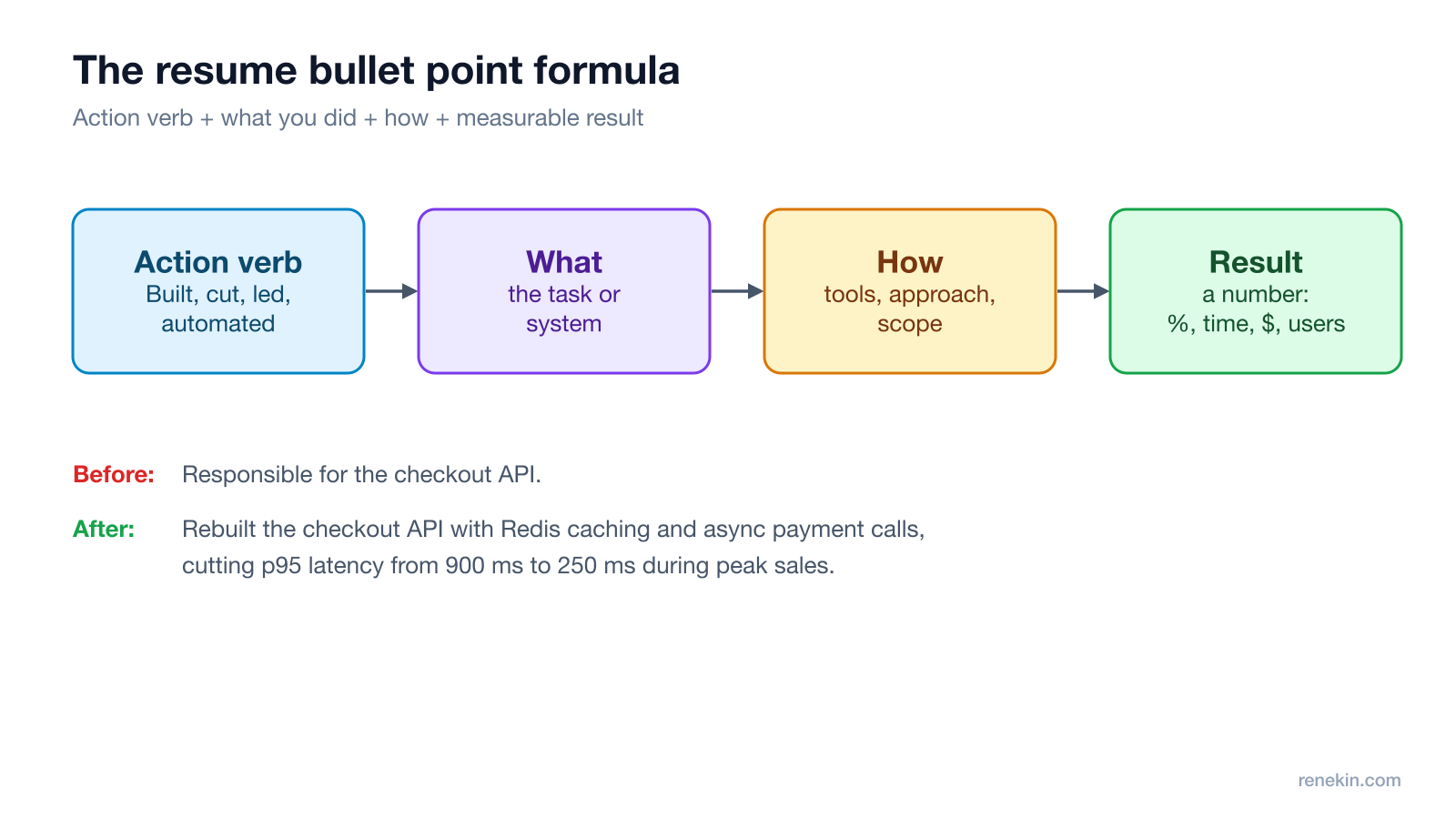
Action verb + what you did + how + measurable result.
- Action verb: built, reduced, automated, led, launched, redesigned.
- What: the system, feature, process or project.
- How: the tools or approach, briefly.
- Result: a number if you can: percent, time, money, users, scale.
Before: Responsible for the checkout API. After: Rebuilt the checkout API with Redis caching and async payment calls, cutting p95 latency from 900 ms to 250 ms during peak sales.
Examples: software engineers
- Before: Worked on backend services. After: Built 6 REST services in Go for order tracking, handling about 2,000 requests per second at peak with 99.9% uptime.
- Before: Fixed bugs. After: Fixed 40+ production bugs in the payments flow and added regression tests, cutting payment-related support tickets by 30%.
- Before: Wrote unit tests. After: Raised test coverage of the billing module from 35% to 80%, catching 3 critical bugs before release.
- Before: Improved database performance. After: Added composite indexes and rewrote 5 slow queries, reducing dashboard load time from 8 s to 1.2 s.
- Before: Helped with deployment. After: Automated deployments with GitHub Actions and Docker, cutting release time from 2 hours to 15 minutes.
- Before: Worked on the frontend. After: Rebuilt the signup flow in React, increasing completed sign-ups by 18% in the first month.
- Before: Did code reviews. After: Reviewed 150+ pull requests and wrote the team's review checklist, reducing review turnaround from 2 days to under 1.
- Before: Handled on-call. After: Wrote runbooks and alerts for 12 services, cutting average incident resolution time by 40%.
Examples: AI and ML engineers
- Before: Built a chatbot. After: Built a RAG support assistant over 4,000 help articles, answering 35% of tickets without an agent.
- Before: Worked on LLM features. After: Reduced LLM cost per request by 60% with model routing and prompt caching, with no drop on our eval set.
- Before: Trained models. After: Fine-tuned a small classification model that matched a large model's accuracy on ticket routing at a tenth of the cost.
- Before: Evaluated models. After: Built an evaluation suite of 500 labelled cases that runs on every prompt change and caught 4 regressions before release.
- Before: Did data cleaning. After: Automated data cleaning for 2M records with pandas and validation checks, saving the team about 6 hours a week.
- Before: Built ML pipelines. After: Moved model training to a scheduled Airflow pipeline, cutting retraining time from 3 days to 6 hours.
Examples: freshers and students
- Before: Made a project on e-commerce. After: Built a full-stack e-commerce app (React, Node.js, MongoDB) with cart, payments and admin panel, used by 50+ classmates in testing.
- Before: Did an internship at a startup. After: Built an internal reporting tool during a 3-month internship that replaced manual Excel reports for a 10-person sales team.
- Before: Participated in a hackathon. After: Led a team of 4 to build an AI note-taking app in 36 hours, placing 2nd out of 120 teams.
- Before: Solved coding problems. After: Solved 400+ data structures and algorithms problems on LeetCode, with a contest rating in the top 10%.
- Before: Was a member of the coding club. After: Organised 6 coding workshops for 200+ juniors as coding club lead, growing attendance by 3 times.
- Before: Did a final-year project on machine learning. After: Built a crop disease detection model with 92% accuracy on a held-out test set, and published it as a web app.
Examples: other roles
- Data analyst. Before: Made dashboards. After: Built 8 Power BI dashboards used weekly by leadership, replacing 5 manual reports.
- Product manager. Before: Managed the roadmap. After: Prioritised the roadmap with usage data, shipping 3 features that raised weekly active users by 12%.
- QA engineer. Before: Tested the app. After: Automated 300 regression tests with Selenium, cutting release testing from 3 days to 4 hours.
- DevOps engineer. Before: Managed cloud servers. After: Moved 20 services to Kubernetes and right-sized instances, cutting cloud costs by 25%.
- Sales. Before: Handled client accounts. After: Managed 40 accounts worth $1.2M a year, with 95% renewal.
- Marketing. Before: Ran social media. After: Grew Instagram followers from 2,000 to 15,000 in 6 months with a weekly content calendar.
- Customer support. Before: Answered customer queries. After: Resolved 60+ tickets a day with a 96% satisfaction score, and wrote 25 help articles that cut repeat questions.
- Operations. Before: Coordinated vendors. After: Renegotiated contracts with 12 vendors, saving 15% a year.
- Team lead. Before: Led a team. After: Led a team of 6 engineers to ship a mobile app in 4 months, rated 4.6 on the Play Store.
- Teacher or trainer. Before: Taught classes. After: Taught Python to 120 students a term, with 85% passing the final project.
All numbers above are examples. Use your own, and only use numbers you can explain in an interview.
Action verbs to start with
- Built: built, developed, designed, launched, implemented, created.
- Improved: reduced, increased, optimised, accelerated, simplified, cut.
- Led: led, mentored, coordinated, owned, drove, organised.
- Fixed: resolved, debugged, migrated, automated, replaced, secured.
Avoid "responsible for", "worked on", "helped with" and "involved in". They describe a duty, not an achievement.
Quick checks before you send
- 3 to 5 bullets per recent role, most impressive first.
- One or two lines each.
- A number in most bullets.
- Keywords from the job description, so applicant tracking systems match you. Test your resume with our free ATS resume checker.
- Consistent tense: past tense for past roles, present tense for your current one.
Rewrite your bullets in seconds
Paste a plain description of what you did into our free resume bullet point generator, and it rewrites it with an action verb, the how, and a result, ready to edit. No sign-up needed.
For more resume help, see how to beat ATS and the AI engineer resume guide.
Frequently asked questions
How do you write a good resume bullet point?
Start with a strong action verb, say what you did and how, and end with a measurable result. For example: "Rebuilt the checkout API with Redis caching, cutting p95 latency from 900 ms to 250 ms."
How many bullet points should each job have?
Usually 3 to 5 for recent roles and 1 to 3 for older ones. Put the most impressive, most relevant bullet first.
What if I don't have numbers for my achievements?
Estimate honestly ("about 20%"), or use other measures of scale and impact: how many users, requests, tickets or teammates, how often, or what changed afterwards. You should be able to explain any number in an interview.
Is there a free resume bullet point generator?
Yes. Renekin AI's free resume bullet point generator rewrites a plain description of your work into achievement-focused bullet points using the action verb and result formula. No sign-up needed.
Try Ghost free
20 free credits, every feature unlocked, hidden from screen share. No card, no subscription.
Download Ghost