Prompt engineering interview questions (2026): what's asked and how to answer
TL;DR
- Expect fundamentals (zero-shot vs few-shot, system prompts, temperature) plus production questions: structured output, reducing hallucinations, prompt injection, versioning and evaluation.
- A production prompt has a clear structure: role and task, rules, a few examples, context, the input, and the output format. Put stable parts first so they can be cached.
- The strongest answers treat prompts like code: versioned, tested against an eval set, and changed one thing at a time.
Prompt engineering questions are standard in AI engineer interviews, but they've changed. Few interviewers care whether you know the phrase "chain of thought". They want to know whether you can write prompts that work reliably in production, and prove it.
Here are the questions that come up most, with answers you can adapt.
Try the free Interview Question Predictor
Paste a job description, get the 10 questions you're most likely to be asked, with answer tips. No sign-up.
Fundamentals
1. What's the difference between zero-shot and few-shot prompting?
Zero-shot: you give instructions only. Few-shot: you add a few examples of input and the ideal output. Few-shot helps most when you need a specific format, labels or tone that's easier to show than describe. Keep examples short, varied and representative: the model imitates them closely, including their mistakes.
2. What is a system prompt, and what goes in it?
The instructions that set up the model's role and rules for the whole conversation, separate from user messages. Put the stable things there: role, task, rules, output format, tool descriptions. The user's input goes in the user message. Keeping trusted instructions apart from user content also helps against prompt injection.
3. What does temperature do?
It controls randomness when the model picks the next token. Low (around 0 to 0.3): more consistent output, good for extraction, classification and factual answers. Higher: more varied output, good for brainstorming or creative writing. Note that low temperature reduces variety; it doesn't guarantee correctness. Some reasoning models fix or limit these settings.
4. What is chain-of-thought prompting? Is it still needed?
Asking the model to reason step by step before answering, which improved accuracy on multi-step problems. Many current models reason internally before they answer, so explicitly asking for it matters less. What still matters: give the model room to think on hard tasks, and don't force a one-word answer to a multi-step problem.
Structure
5. How do you structure a production prompt?
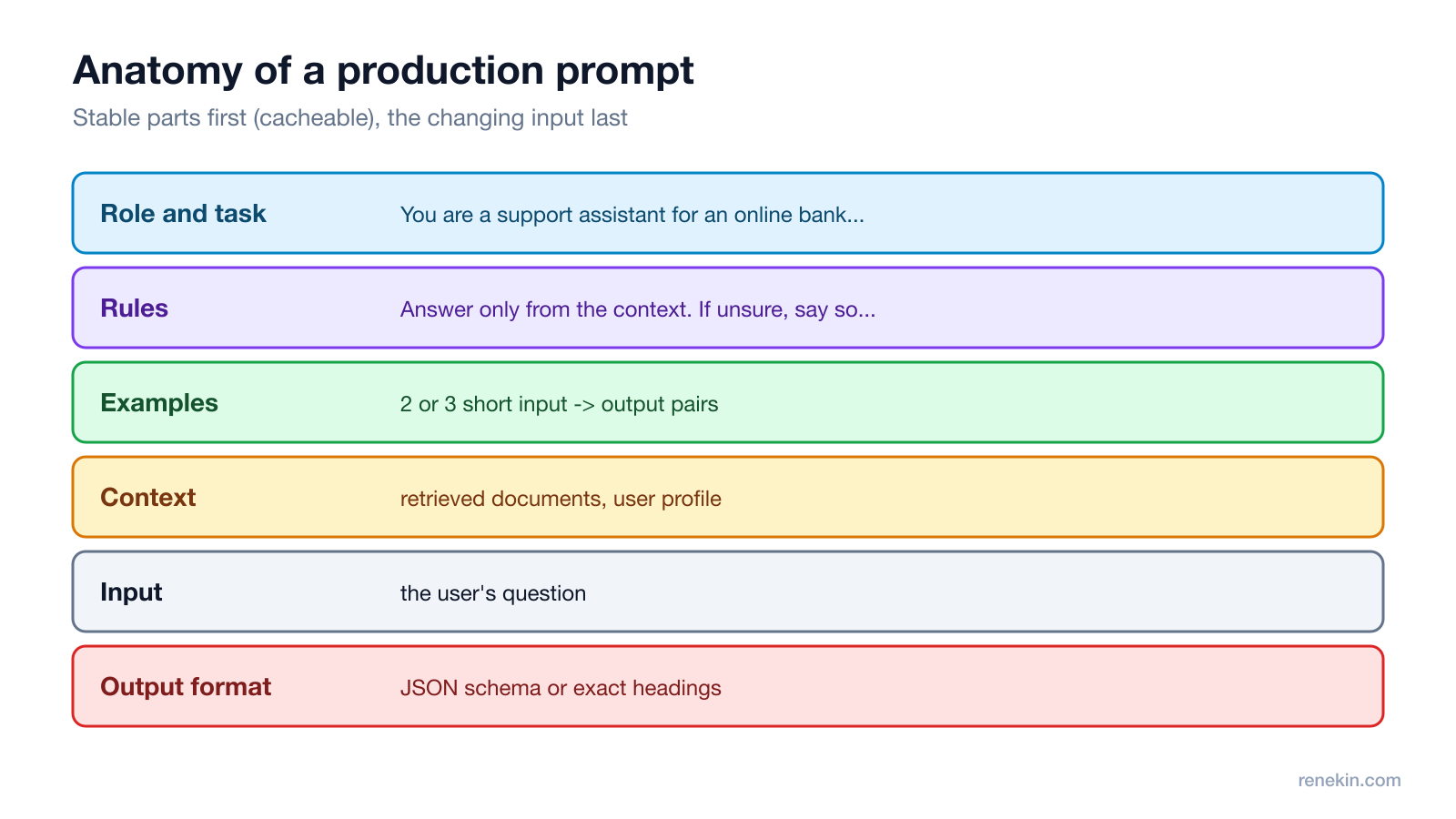
A clear, repeatable order:
- Role and task: who the model is and what it does.
- Rules: what to do and not do, and how to handle edge cases ("If the answer isn't in the context, say you don't know").
- Examples: two or three, if the format is tricky.
- Context: retrieved documents, user data.
- Input: the user's question.
- Output format: exact headings or a JSON schema.
Use clear separators (headings or XML-style tags) between sections, so the model never confuses your instructions with the user's text.
6. How do you get reliable JSON output?
Use the provider's structured output or tool calling feature with a JSON schema, which constrains the output to the schema. Without it: describe the schema, show an example, validate the result in code, and retry once with the validation error if it fails. Keep schemas simple: fewer nested objects, enums for fixed choices.
Quality and reliability
7. How do you reduce hallucinations?
- Ground the model: put the needed facts in the context (that's what RAG is for).
- Permission to say "I don't know" when the context doesn't cover the question.
- Ask for citations to the source passages, and check them in code if you can.
- Lower temperature for factual tasks.
- Measure it: a hallucination rate on an eval set, not a feeling.
8. Your prompt works 90% of the time. How do you fix the other 10%?
Collect the failures and group them: wrong format, missing information, misunderstood instruction, wrong tone. Fix the largest group first, usually by adding a rule or an example for that case, or by improving the context. Then rerun the full eval set, because prompt fixes often break something that used to work.
9. How do you version and test prompts?
Treat prompts like code: store them in version control, review changes, and run them against an eval set (realistic inputs with expected outputs or scoring rules) before every release. Track scores over time so you notice regressions. Our LLM evals post shows how to run this in CI.
10. How would you evaluate output that has no single right answer, like a summary?
Combine checks: rules in code (length, required sections, no banned phrases), an LLM judge with a clear scoring rubric (checked against human ratings on a sample), and regular human review of a small set. Compare new prompt versions side by side on the same inputs.
Security
11. What is prompt injection, and how do you defend against it?
Instructions hidden in untrusted content, such as a document, web page or email, that try to override yours. Defences: keep trusted instructions separate from untrusted content, mark untrusted content clearly, limit what the model can do (permissions, tools), require approval for sensitive actions, and filter outputs. No prompt alone fully prevents it. Details in prompt injection in AI agents.
12. How do you stop the model from revealing the system prompt?
You can ask it not to, but assume a determined user can extract it. Never put secrets (API keys, internal URLs, private data) in a prompt. Treat the prompt as public and keep real protection in code.
Cost and speed
13. How do you make a prompt cheaper and faster?
- Prompt caching: keep the stable part (system prompt, tool definitions, examples) at the start and identical across requests, so providers can reuse it at a lower cost and latency.
- Shorter prompts: remove repetition and unused instructions; include only relevant context.
- Smaller models for simple steps, with routing to bigger ones only when needed.
- Limit output length when you don't need long answers.
See how to reduce LLM latency and cost for more.
14. Prompt engineering, RAG or fine-tuning: how do you choose?
Start with prompting: it's fastest to change. Add RAG when the model needs knowledge it doesn't have (your documents, fresh data). Consider fine-tuning when you need a consistent style or format at scale that prompting can't reach, or to make a smaller model do one job well. We compare them in fine-tuning vs RAG.
A practical exercise you may get
"Here's a prompt that extracts invoice fields and sometimes returns broken JSON. Improve it."
A strong answer: switch to structured output with a schema; add rules for missing fields ("use null, don't guess"); add one example of a messy invoice; move the invoice text into a clearly marked section; validate in code and retry once on failure; and build a small eval set of 30 real invoices to measure the improvement.
That's the mindset interviewers want: clear structure, constraints in code, and evidence.
Frequently asked questions
What questions are asked in a prompt engineering interview?
Common ones: the difference between zero-shot and few-shot prompting, what a system prompt is for, how temperature affects output, how to get reliable JSON, how to reduce hallucinations, what prompt injection is, and how you test and version prompts in production.
What is few-shot prompting?
Few-shot prompting means including a few examples of inputs and the desired outputs in the prompt, so the model copies the format and style. It's useful for specific formats, labels or tone. Examples should be varied and representative, since the model imitates them closely.
How do you reduce hallucinations with prompting?
Give the model the facts it needs in the context (retrieval), tell it to answer only from that context and to say when it doesn't know, ask it to cite which source each claim came from, and lower the temperature for factual tasks. Then measure the hallucination rate on an eval set.
Is prompt engineering still important in 2026?
Yes, but it has become part of AI engineering rather than a separate job. Models follow plain instructions better than before, so the focus has moved to giving the right context, defining structured outputs, defending against injection and testing prompts systematically.
Try Ghost free
20 free credits, every feature unlocked, hidden from screen share. No card, no subscription.
Download Ghost