How to reduce LLM latency and cost: streaming, prompt caching and model routing
TL;DR
- Measure first: time to first token, total time, input and output tokens, and cost per request.
- Streaming makes answers feel fast; capping output and trimming the prompt make them actually faster and cheaper.
- Cache the stable start of your prompt, route easy requests to a smaller model, and use batch APIs for work that can wait.
LLM features get slow and expensive fast. A typical interview question: "Our AI feature takes 8 seconds to answer and the bill doubled last month. What would you do?" The strong answer starts with measurement, then uses a handful of levers, each aimed at a specific cost.
Try the free Interview Question Predictor
Paste a job description, get the 10 questions you're most likely to be asked, with answer tips. No sign-up.
Step 1: Measure before changing anything
Log for every request:
- Time to first token (TTFT) and total time.
- Input tokens and output tokens. Output is usually priced higher and is generated one token at a time, so it drives both cost and latency.
- Cost per request and per user, by feature.
- Whether a cache was used, and which model handled it.
Then find the biggest cost. Very often it's a huge prompt resent on every request, or answers far longer than needed.
Step 2: Stream, and shorten the output
- Stream tokens so the first words appear quickly. A 6-second answer that starts after half a second feels fast.
- Cap output length with a max-token limit and clear instructions: "Answer in 3 bullet points." Shorter output is cheaper and faster.
- Ask for structure, like JSON with only the fields you need, instead of prose you then parse.
Step 3: Route requests to the right model
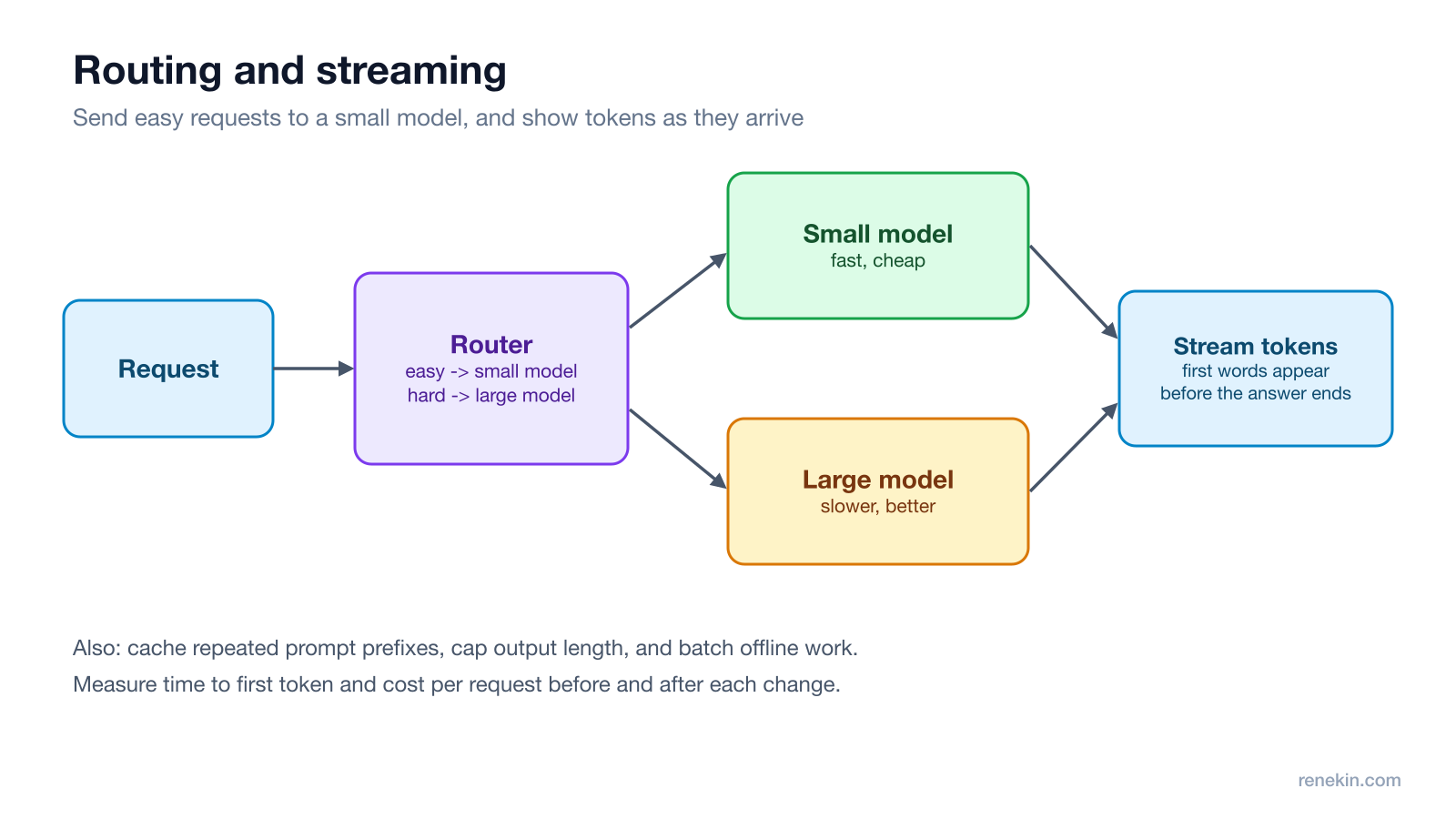
Not every request needs the biggest model. Classifying a support ticket or extracting a date works fine on a small model at a fraction of the cost and time.
- Start with simple rules: by feature, input length or user tier.
- Upgrade to a classifier or a small model that decides, if needed.
- Fall back to the larger model when the small one's answer fails validation.
- Check quality with an eval set before and after, as in LLM evals that catch regressions.
Step 4: Cache what repeats
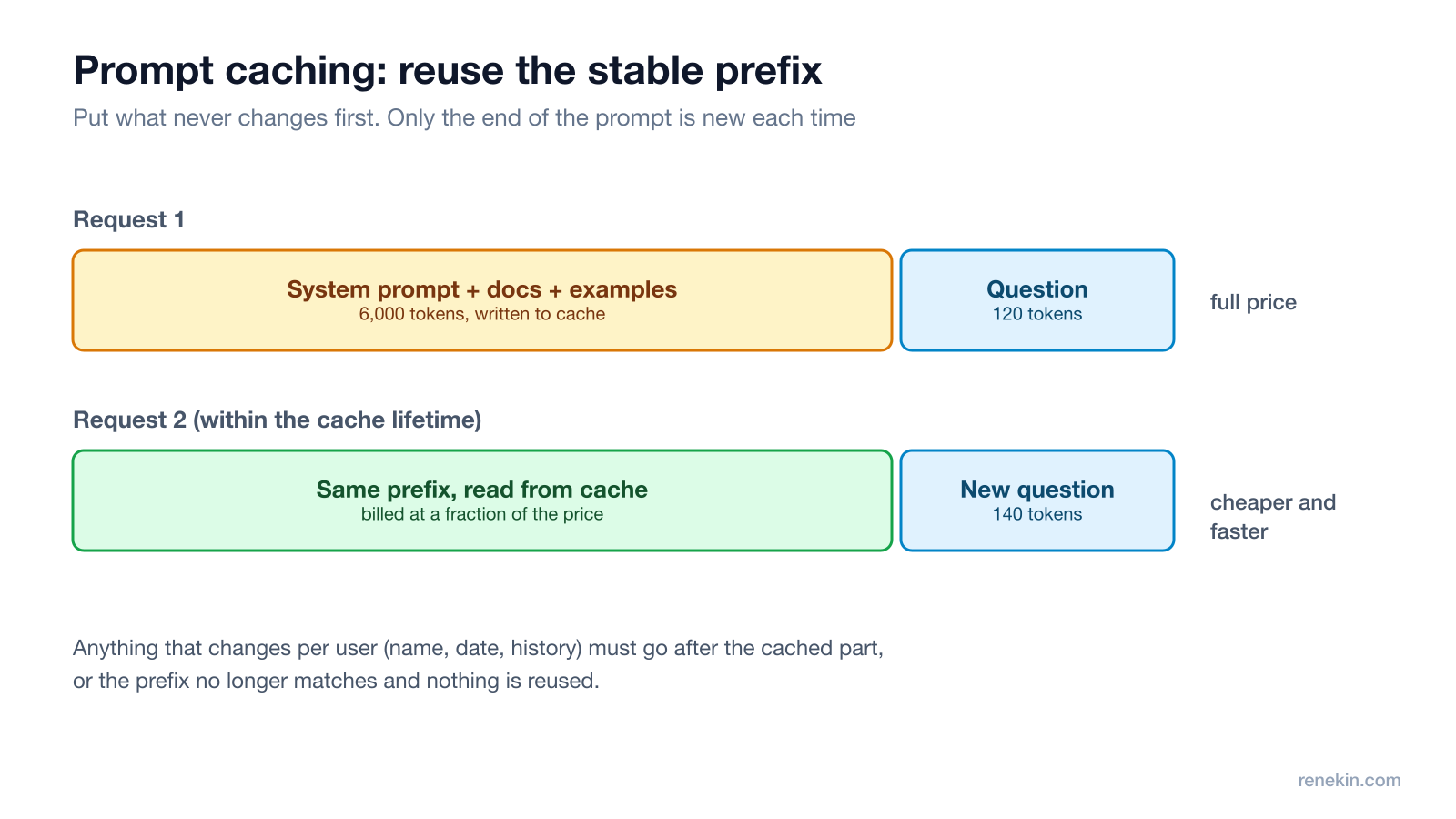
- Prompt caching: most providers can reuse the processed start of a prompt if it's identical between requests. Put the system prompt, documents and examples first, and anything that changes per request, like the user's question or the date, last. Cached input is billed at a fraction of the normal rate and is faster (Anthropic: prompt caching, OpenAI: prompt caching). Check each provider's minimum prompt length and how long the cache lasts.
- Response caching: if many users ask the same thing, cache the answer itself. For questions that are similar but not identical, see semantic caching.
Step 5: Trim the prompt and batch what can wait
- Retrieve less, retrieve better: send the 5 most relevant chunks, not 30. Better retrieval cuts tokens and often improves answers.
- Summarise long chat history instead of resending every message.
- Batch APIs: for work that doesn't need an instant answer, like nightly summaries or bulk classification, batch endpoints are typically much cheaper in exchange for slower turnaround.
The one-line answer
"I'd measure time to first token, tokens and cost per request first. Then stream responses, cap output length, route easy requests to a smaller model with an eval to protect quality, put the stable prompt first so prompt caching applies, trim retrieval and history, and batch anything that can wait."
Follow-up questions to expect
- "How do you know quality didn't drop?" Run the eval set on every change and watch user feedback and retry rates.
- "Streaming with structured output?" Stream partial JSON, or stream the prose part and send structured data at the end.
- "Self-host to save money?" Only at high, steady volume, and after counting GPU, operations and quality costs.
Frequently asked questions
What is time to first token?
Time to first token (TTFT) is how long a user waits before the first words of a model's answer appear. With streaming, it is what users feel as speed, even if the full answer takes longer.
How does prompt caching reduce LLM cost?
Prompt caching stores the processed start of a prompt, such as a long system prompt and documents. Later requests that begin with exactly the same prefix reuse it, which is billed at a much lower rate and returns faster. It only works if the stable content comes first and the changing content comes last.
What is model routing?
Model routing sends each request to the cheapest model that can handle it well: simple requests go to a small, fast model and hard ones to a larger model. The router can be rules, a classifier or a small model.
Do output tokens cost more than input tokens?
With most major LLM APIs, yes. Output tokens are usually priced several times higher than input tokens and are generated one at a time, so long answers drive both cost and latency.
Try Ghost free
20 free credits, every feature unlocked, hidden from screen share. No card, no subscription.
Download Ghost