URL shortener system design: a step-by-step interview answer
TL;DR
- Start with requirements and estimates: redirects far outnumber new links, so the design is built around a fast, cached read path.
- Generate codes from a counter, handed out to servers in blocks, and encode each number in base62. Seven characters give about 3.5 trillion codes and no collisions.
- Serve redirects from a cache in front of a key-value or SQL store, use 302 if you need click analytics, and record clicks asynchronously.
"Design a URL shortener" is often the first system design question you'll get, because it's small enough to finish in 45 minutes and still touches IDs, storage, caching and scale. The goal isn't a perfect design. It's a clear, structured one.
The interview prompt: "Design a service like TinyURL. Users paste a long URL and get a short link that redirects to it."
Try the free Interview Question Predictor
Paste a job description, get the 10 questions you're most likely to be asked, with answer tips. No sign-up.
Step 1: Agree on requirements
Functional:
- Create a short link for a long URL, optionally with a custom alias and an expiry date.
- Redirect the short link to the long URL.
- (Optional) Count clicks.
Non-functional:
- Redirects must be fast and highly available. A broken short link breaks someone else's page.
- Codes should be short and not easy to guess, if links can be private.
Step 2: Do quick estimates
Pick round numbers and say them out loud. For example, 100 million new links a month and 100 reads for every write:
- Writes: 100M / (30 x 86,400 s) is about 40 per second.
- Reads: about 4,000 redirects per second on average, with peaks several times higher.
- Storage: about 500 bytes per link x 100M x 12 months x 5 years is about 3 TB.
The conclusion matters more than the exact numbers: this is a read-heavy system, so the design centres on a fast, cached read path.
Step 3: Sketch the API and the design
POST /shorten   { "url": "https://...", "alias": null, "expires_at": null }  -> { "code": "aB3x9Kq" }
GET  /{code}    -> 302 redirect to the long URL
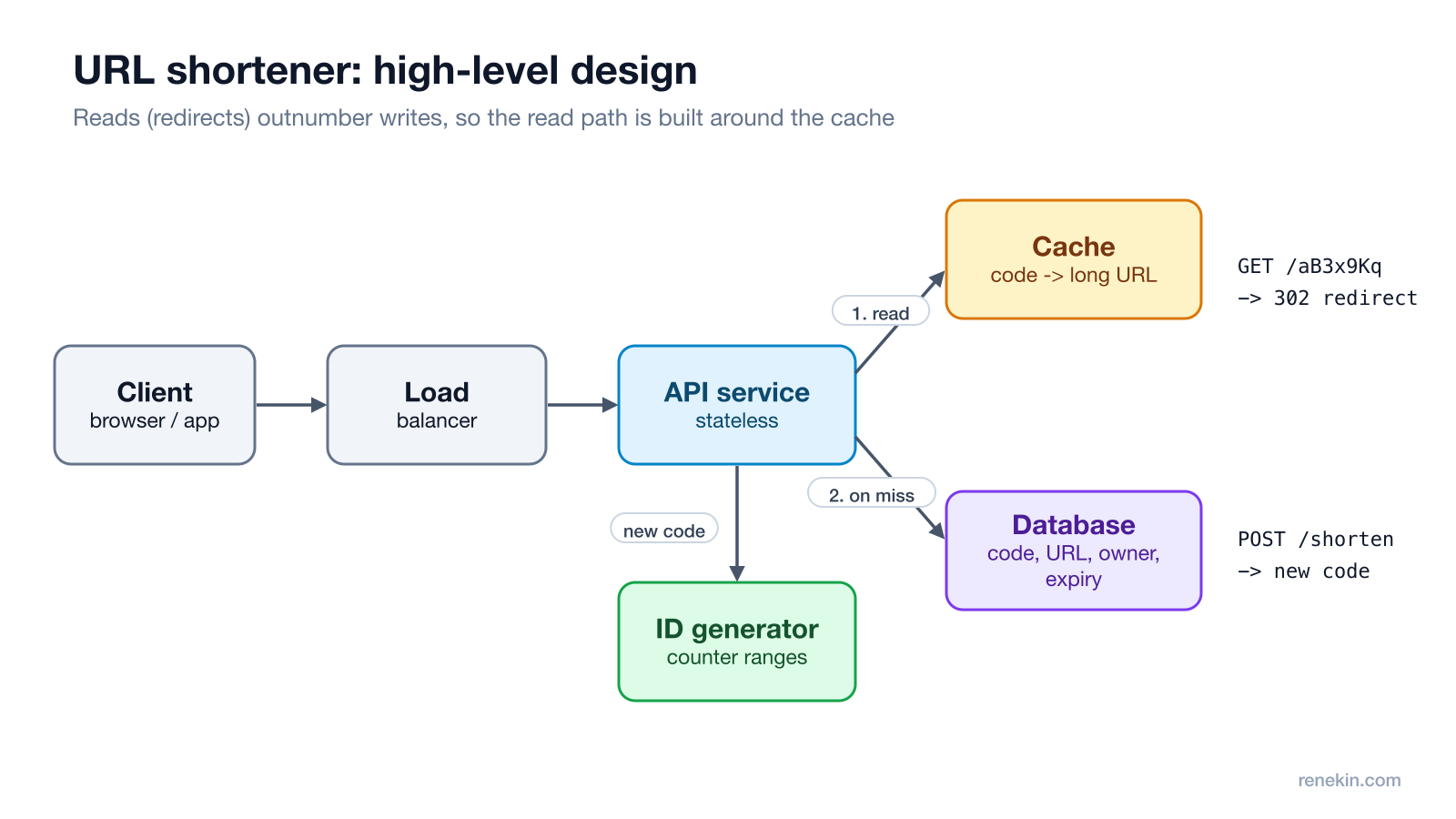
- API service: stateless, so you can add servers behind the load balancer.
- Cache: code to long URL, for popular links.
- Database: code (primary key), long URL, owner, created and expiry times.
Step 4: Generate the short code (the core of the question)
There are two main approaches.
A) Hash the URL (for example MD5 or SHA-256) and take the first 7 characters. Simple, and the same URL can map to the same code, but different URLs can collide, so you must check the database and retry on a clash.
B) Counter plus base62 (usually the better answer). Give every link a unique number and encode it with the 62 characters 0-9, a-z and A-Z.
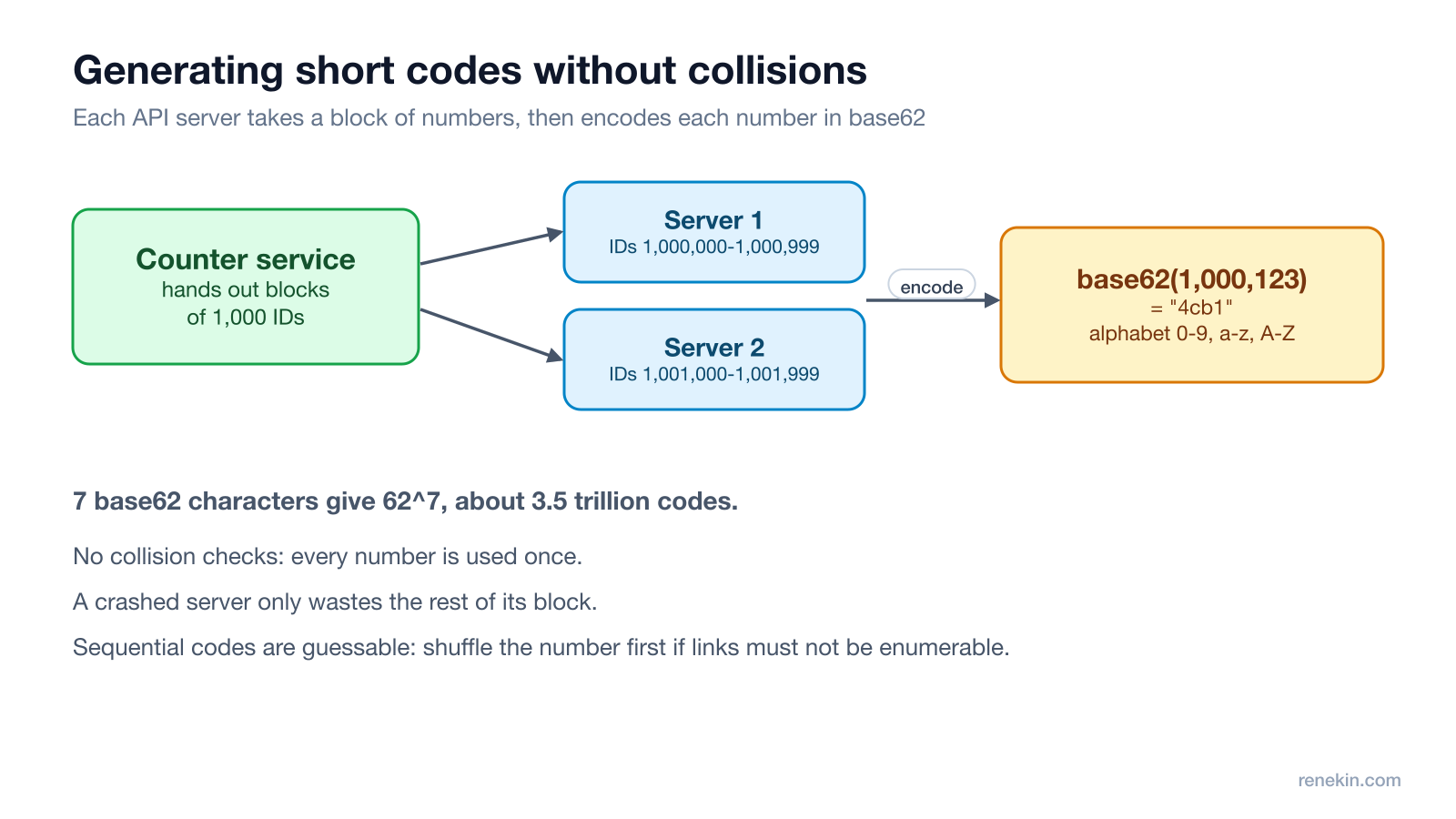
- 7 characters give 62^7, about 3.5 trillion codes, which is plenty.
- A single counter would be a bottleneck, so a counter service hands out blocks (say 1,000 IDs) to each API server. Servers then create codes from memory with no coordination.
- No collisions are possible, because each number is used once. If a server crashes, you just lose the rest of its block.
- Sequential numbers produce guessable codes. If that matters, shuffle the number with a reversible scramble before encoding, or add a few random characters.
Custom aliases go through the same table: insert with a unique constraint and return an error if the alias is taken.
Step 5: Make redirects fast
- Look up the code in the cache (for example Redis).
- On a miss, read from the database and fill the cache.
- Return the redirect.
A small share of links gets most of the clicks, so even a modest cache has a high hit rate. Cache "not found" results briefly too, so bots hitting random codes don't hammer the database.
301 or 302? A 301 (permanent) lets browsers cache the redirect, which saves load but means later clicks never reach you. A 302 (temporary) sends every click through your service, which you need for click analytics and for links that can be edited or expire.
Step 6: Scale and harden it
- Storage: the lookup is always by code, so a key-value store scales easily; a relational database with the code as primary key also works for a long time. Shard by code if needed, for example with consistent hashing.
- Analytics: don't write a row per click in the redirect path. Publish click events to a queue and aggregate them asynchronously. (See Kafka vs RabbitMQ vs SQS.)
- Abuse: rate limit link creation per user and IP (see rate limiter system design), and check new URLs against malware and phishing lists.
- Expiry: delete expired links with a background job, and check expiry on read.
The one-line answer
"It's read-heavy, so I'd build around a cached redirect path. Codes come from a counter handed out in blocks and encoded in base62, so seven characters give about 3.5 trillion codes with no collisions. Redirects use 302 for analytics, clicks go to a queue, and creation is rate limited."
Follow-up questions to expect
- "What if the same long URL is shortened twice?" Either allow two codes (simpler, and lets each user track their own clicks) or look up an index on the long URL first and reuse the code.
- "How do you keep the counter service from being a single point of failure?" Run it with a replicated store, and have servers fetch the next block before the current one runs out, so a short outage doesn't block writes.
- "How would you handle a link that goes viral?" It's already in the cache; add a small in-memory cache on each API server for the hottest codes.
Frequently asked questions
How does a URL shortener generate short codes?
The most common approach is a unique number from a counter, encoded in base62 (0-9, a-z, A-Z). To avoid a single bottleneck, a counter service hands out blocks of numbers to each server. The alternative is hashing the long URL and taking a prefix, which needs collision checks.
How many URLs can 7 base62 characters represent?
62 to the power of 7, which is about 3.5 trillion codes.
Should a URL shortener use a 301 or 302 redirect?
A 301 is permanent, so browsers may cache it and skip your server on later clicks, which saves load but loses click counts. A 302 is temporary, so every click reaches your server, which is what you want for analytics.
Which database should a URL shortener use?
The main access pattern is a lookup by short code, so a key-value store works well at very large scale. A relational database with an index on the code is also fine for most sizes and makes features like user accounts easier.
Try Ghost free
20 free credits, every feature unlocked, hidden from screen share. No card, no subscription.
Download Ghost